

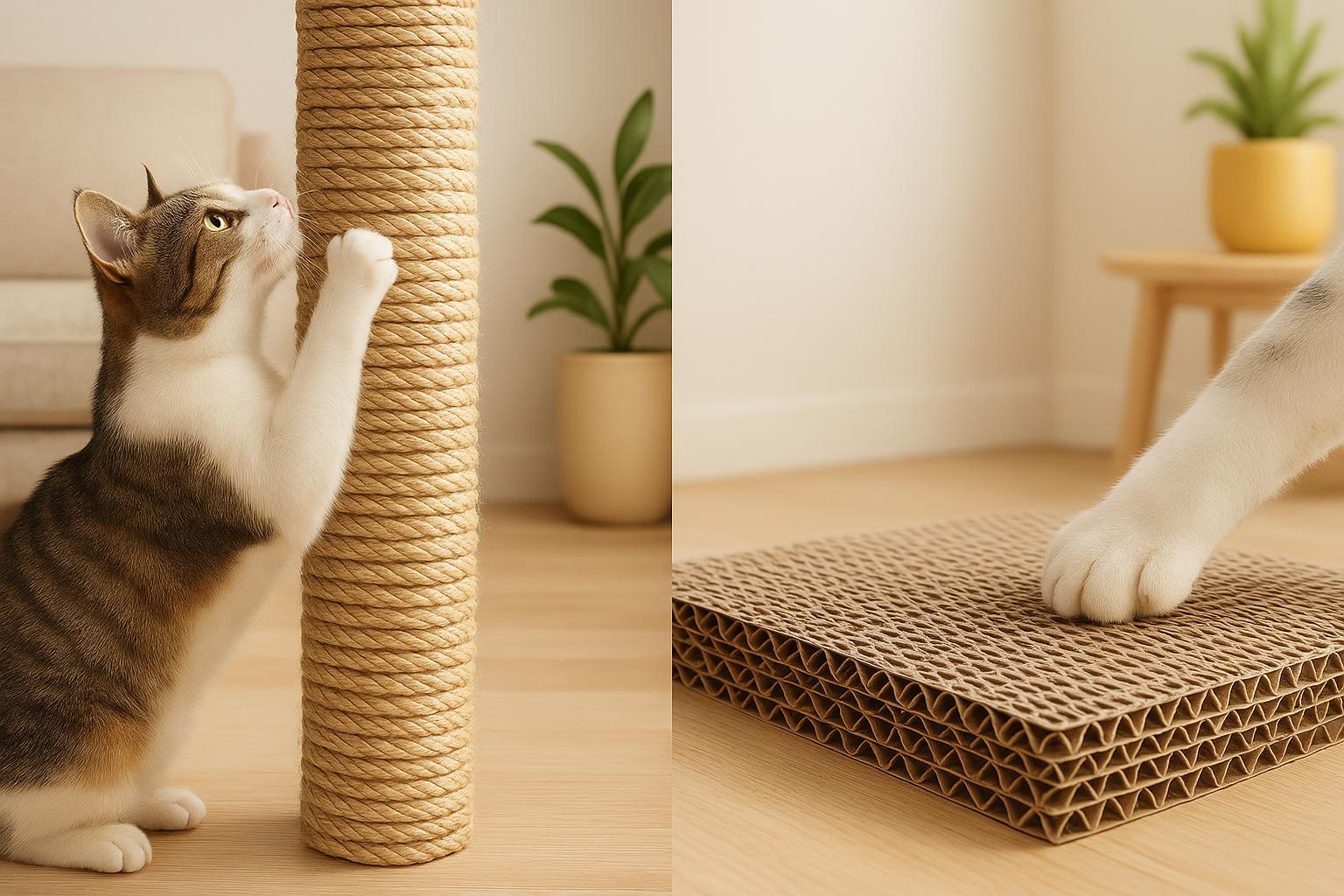
If you’re deciding between a sisal vs cardboard scratching post, here’s the deal: your cat’s behavior—not just the price tag—should drive the choice. In 2026, the best pick still depends on texture preference, stability for a full-body stretch, mess tolerance, and how often you want to replace the thing. Below you’ll find a fast, fair comparison, behavior-science context, scenario picks, and clear cost math to help you stop furniture damage without guesswork.
We don’t crown a single universal winner. Instead, we explain where each material excels, backed by credible behavior and care guidance. When we reference outside facts, we link directly to the source and keep our link count lean for readability.
Quick comparison — sisal vs cardboard scratching post (2026)
The snapshot below compares the two materials across 11 decision factors readers ask about most.
| Decision factor | Sisal | Cardboard |
|---|---|---|
| Durability & wear resistance | Typically lasts longer; rope or tightly woven fabric resists fraying under average-to-heavy use. | Shreds easily; effective but tends to wear out in weeks to a few months for active cats. Source context: see the durability notes in the Cats.com overview of scratchers. |
| Cat engagement & texture fit | Bark-like, grippy texture that many cats love for claw sheath shedding and a satisfying pull. Offering both vertical and horizontal options boosts success. Guidance aligns with International Cat Care’s advice to offer varied textures. | Soft, shreddy feel with immediate feedback some cats find irresistible, especially on horizontal pads and loungers; variety can improve engagement. |
| Stability & best form factor | Dominates taller vertical posts and wall panels; easier to find stable designs that support full-body stretch (often 28–32 inches tall with wide bases). | Most common as horizontal pads or loungers; great for floor-level scratching but less often tall-and-stable for full stretch. |
| Mess & cleanliness | Tends to shed fewer visible flakes; fibers can fuzz but usually less debris overall. | Produces flakes/dust as it shreds; quick to vacuum but more frequent cleanup. |
| Sustainability & disposal | Natural agave fiber; biodegradable; end-of-life depends on mixed materials and local rules. | Paper-based; recyclable only when clean and dry—used scratchers are often too soiled for curbside recycling per EPA guidance. |
| Total cost of ownership (TCO) | Higher upfront, often lower annualized cost if it lasts 6–24 months or more. | Lower upfront, higher replacement cadence can raise annual cost for heavy users. |
| Maintenance & replaceability | Some designs allow rope rewraps or modular panel swaps to extend life; spot-cleanable. | Many pads are reversible (doubles life) but are fully replaced when spent. |
| Aesthetics & home fit | Wide décor range, from minimalist boards to furniture-like posts; visible vertical footprint. | Low-profile, compact, easy to tuck near problem areas; often neutral cardboard tones. |
| Safety & chemicals | Natural fiber favored in many guides; always verify finishes/adhesives. | Generally safe but depends on glues/inks; check for non-toxic claims where possible. |
| Availability & variety | Strong selection in vertical posts, boards, and wall-mount panels. | Extremely common across pads, loungers, ramps, and hangers—especially at budget tiers. |
| Noise level | Moderate scratch sound; varies by weave and mounting surface. | Often perceived as slightly quieter, with a soft shredding sound. |
If you need the longest life and a stable vertical post for full-body stretch, choose sisal. If you want a budget-friendly, low-profile option to test locations or keep things quiet, choose cardboard. Many homes do best with both: a sturdy sisal post near favorite resting spots and one or two cardboard pads parked where furniture scratching shows up.
Why cats scratch (and how texture and placement change outcomes)
Cats don’t scratch to spite you. They do it to maintain claws (shedding outer sheaths), stretch their back and shoulder muscles, and leave scent and visual marks. Behavior authorities recommend offering multiple scratching options and putting them where your cat actually wants to use them—near sleeping areas, traffic paths, or the furniture they already target. International Cat Care advises providing varied textures and orientations to accommodate individual preference, which reduces conflict in multi-cat homes and increases uptake of scratchers; see the guidance in the resource on making a home cat friendly from International Cat Care (ICC).
Positive reinforcement matters as much as material. Reward and praise every time your cat uses the desired surface—no scolding for mistakes and no forcing paws onto the post. The American Veterinary Society of Animal Behavior outlines why reward-based training builds lasting habits without stress; for a short, practical overview, see AVSAB’s training guidance on getting started with cats.
Not all sisal is the same. Sisal rope vs sisal fabric creates different scratch feels: rope has ridged grooves many cats dig into; tightly woven fabric feels flatter but can wear more evenly. Orientation also changes the experience. Vertical posts (commonly sisal) encourage a full-body stretch, while horizontal pads (often cardboard) can be friendlier to seniors or cats that naturally choose floor-level scratch targets. Preventive behavior resources, like the overview from Preventive Vet on why cats scratch and how to protect furniture, emphasize pairing the right texture with the right placement so the post becomes your cat’s preferred outlet.
- Authority references used in this section:
- International Cat Care’s guidance on making your home cat friendly supports offering varied textures and smart placement: see the ICC article on creating a cat-friendly home.
- AVSAB’s beginner training article reinforces positive reinforcement basics: see AVSAB’s “get started” training guidance.
- Preventive Vet’s explainer on scratching connects texture, placement, and habit-building: see the Preventive Vet guide on scratching and furniture.
Scenario picks: choose based on your space, cat, and budget
Longevity and full-body stretch
Pick sisal in a tall, stable post or wall-mounted board if you want the fewest replacements and the best ergonomics. Look for a wide, heavy base and a height that lets your cat stretch fully (often 28–32 inches). Place it near a favored nap spot or right next to the sofa corner your cat targets.
Budget, quiet, and low-profile
Pick cardboard pads or loungers when you want the smallest footprint and the lowest upfront cost. They’re easy to scatter where scratching happens and can be flipped to extend life. For apartments or noise-sensitive spaces, their soft shredding sound is often less disruptive.
Multi-cat or heavy scratchers
Pick sturdier sisal designs (rope-wrapped or dense fabric) that keep texture under heavy use. Consider modular builds that let you swap panels or rewrap rope. Place multiple scratchers—one per cat plus one extra—so competition doesn’t push scratching back onto furniture.
Seniors or mobility-limited cats
Pick horizontal options first (cardboard or low-profile sisal boards). Ensure non-slip placement and keep scratchers near preferred rest areas to reduce effort.
Cost over time — simple TCO math (as of 2026-03-11; prices subject to change)
Annual cost depends on both purchase price and lifespan.
- Example, light user: A $12 cardboard pad lasting about 4 months costs roughly $36/year. A $50 sisal post lasting 24 months costs about $25/year.
- Example, average user: A $12 cardboard pad lasting 2 months costs roughly $72/year. A $50 sisal post lasting 12 months costs about $50/year.
- Example, heavy user: An $8 cardboard pad lasting 1 month costs roughly $96/year. A $60 sisal board lasting 12 months costs about $60/year.
These examples align with common market ranges reported by major retailers and editors—cardboard is cheap up front but replaced more frequently, while sisal’s higher initial price may yield lower yearly spend if it lasts at least a year in your home.
For context on why cardboard tends to be shorter-lived and sisal longer-lived, see the durability framing in the Cats.com buyer’s overview of scratchers, which notes that cheap cardboard shreds quickly while durable sisal can last much longer under regular use.
How to migrate a cat from cardboard to sisal (2–6 weeks)
- Place the new sisal post or board directly next to the cardboard pad your cat already uses. Rub with a soft cloth your cat has slept on to transfer familiar scent. Reward any interest.
- Make the sisal option more attractive: position it where your cat greets you or near the sofa corner they target. Offer a treat or a play session that ends at the post, then mark and praise every scratch.
- Gradually reduce access to the cardboard pad once you see reliable use of the sisal (typically after 2–3 weeks). If scratching backslides, restore both options for another week and increase rewards at the sisal.
Behavior resources such as the training guidance from the American Veterinary Society of Animal Behavior and the practical tips from Preventive Vet emphasize immediate reinforcement, good placement, and avoiding aversives—all of which speed up this migration without stress.
FAQ
Q: Do cats prefer sisal or cardboard?
A: Preferences vary. Some cats love the grippy, bark-like pull of sisal; others want the soft shred of cardboard, often in a horizontal format. Providing both orientations and at least two textures raises the odds your cat uses them consistently. This aligns with International Cat Care’s recommendation to offer varied scratching options and to place them where your cat spends time and marks.
Q: How long do cardboard scratchers last?
A: It depends on your cat’s vigor and how many cats share the pad. Many homes see a few weeks to a few months of effective use per pad, especially if it’s reversible. Editorial roundups frequently describe cardboard as fast-shredding, while sisal is cited as more durable over the long run. For one durability-oriented explanation, see the Cats.com overview of scratching posts.
Q: Where should I put a post to stop furniture scratching?
A: Right where your cat wants to scratch—near sleeping areas, entrances, or the furniture corner they target. Choose a tall, stable post for vertical scratchers or a low-profile pad for floor-scratchers. Reinforce with treats and praise immediately. This placement-and-reward approach is echoed across behavior resources like the International Cat Care home-friendly guide, AVSAB’s training basics, and the Preventive Vet scratching overview.
Where to browse next
If you’re exploring low-profile boards or vertical posts, you can browse sisal boards, mats, and other toys from LOVEPETIN here: LOVEPETIN cat toys and scratchers collection. We recommend comparing dimensions, base stability, and materials before purchasing.
Methodology and sources
This comparison focuses on materials rather than specific models and reflects practical behavior guidance and commonly reported product characteristics as of March 11, 2026. For behavior and care context, we referenced:
- International Cat Care’s guidance on creating a cat-friendly home: see the ICC article on making your home cat friendly (2026 retrieval).
- AVSAB’s training basics for cats: see AVSAB’s get-started training article (2026 retrieval).
- Preventive Vet’s explainer on scratching, placement, and reinforcement (2026 retrieval).
- Cats.com’s durability-oriented buyer’s overview of scratching posts (2026 retrieval).
- A scientific review of sisal’s biodegradability from a peer‑reviewed source (2025–2026 retrieval).


